
What a meeting costs: the one expense approved without seeing the price
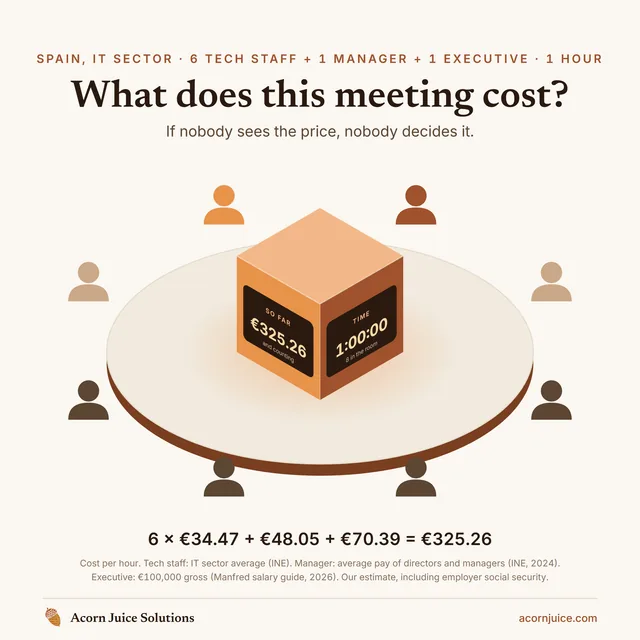
A one-hour meeting with six tech staff, a manager and an executive costs a Spanish technology company about €325. Nobody in the room knows. And hardly anyone asks, because a meeting is the one company expense that gets approved without seeing the price.
The numbers, from public data
We have not made up any figure, but no source publishes the hourly cost of each role as such either. We worked it out, and the detail is at the end for anyone who wants to redo it.
- Tech staff: €34.47 an hour. This is the average for the information and communications sector according to INE, Spain’s national statistics office: what each hour actually worked costs the employer, salary and social security included, with holidays and absences taken out.
- Manager: about €48 an hour. Based on the average salary INE publishes for the directors and managers group, plus the employer’s social security contributions.
- Executive: about €70 an hour. We start from €100,000 gross a year, at the cautious end of what salary guides report for an experienced technology lead, and add social security.
Six times €34.47, plus €48.05, plus €70.39: €325.26. If that meeting happens every week, it adds up to about €14,000 a year. For a single recurring meeting.
Cost is not a billing rate
When we show this figure, the most common reaction is that it looks low. That makes sense: anyone in consulting is used to rates of €55, €75 an hour or more. But those are selling prices. They include margin, overheads, sales time and every hour that never gets billed. What we calculate here is something else: what it costs the company to have those people sitting in that room.
If your company bills by the hour, the real figure is worse still. On top of the cost, add what those eight hours fail to bill. That is why we call this a cautious estimate: it is the floor, not the ceiling.
The expense nobody signs off
The problem is not that meetings are expensive. Many are worth it. The problem is that they are the only spending decision made without seeing the price.
Nobody would approve a €14,000 purchase with a calendar invite. They would ask for a quote, compare options and ask whether it is really needed. A weekly eight-person meeting gets approved with one click, renews itself and is never reviewed.
And that is only the meetings you can see. Microsoft found, using Microsoft 365 usage data from outside the European Union, that 57% of meetings are ad hoc calls with no invite. They leave no trace in a calendar, so they leave none in any budget either.
Asynchronous work already does most of the job
The long “let’s all catch up” meeting comes from a time when there was no other way to keep a team aligned. Today there is, and it usually works better.
With asynchronous communication, each person reads when they can, at their own pace and without breaking off what they were doing. They comment in writing, with time to think about the reply. And there is a record: whoever joins tomorrow, or was on holiday, does not depend on someone remembering to tell them.
In practice, much of what meetings handle today fits other formats:
- A project’s status fits in a short, up-to-date note. Reading it takes two minutes; hearing it read aloud to eight people takes an hour.
- A proposal is easier to understand written down and commented on in the document itself than presented with slides.
- An explanation people need to see can be a short recorded video that everyone watches when it suits them, and can rewatch.
- Decisions are written down, with their reasoning, somewhere everyone knows.
The meeting does not disappear. It is kept for what genuinely needs a conversation: deciding something where opinions clash, unblocking a problem that has been stuck for days, or resolving a conflict. For that, talking live is still irreplaceable. For reading a project’s status aloud, it is not.
An idea: putting the price on the table
Imagine having a counter in the middle of the table, or in MS Teams / Slack. A cube that keeps adding up euros while people talk, in plain sight. For now it is only an idea we keep turning over, but we are clear about a couple of things it should be.
It would work with average costs per role, never with anyone’s payslip. A counter that matched the attendee list against each person’s salary would be processing sensitive personal data, and would turn a tool for thinking into a tool for surveillance. Each company could set its own bands per role, but nobody would see what a specific colleague costs.
And it would not be there to single anyone out. It would be there so that, seeing the figure, someone asks whether eight people were really needed, or whether a shared document and a thread would have done.
How we calculated it
For anyone who wants to check it or adapt it to their own company:
- Tech staff. Labour cost per worker per month in the information and communications section in Q2 2026 (€5,004.50, INE Quarterly Labour Cost Survey) divided by effective hours per worker per month in that quarter (145.2 hours, INE table 6045): €34.47 an hour. The same method applied to the national total (€3,388.15 over 129.4 hours) gives €26.18, the figure INE itself publishes.
- Manager. Average salary of directors and managers in 2024 (€63,865.45, INE Annual Wage Structure Survey, all sectors). Since it exceeds Spain’s 2024 maximum contribution base (€4,720.50 a month), employer contributions are calculated on that base: 31.98%, adding common contingencies, unemployment, the wage guarantee fund, vocational training, the intergenerational equity mechanism and occupational accidents at the office rate. Annual cost: about €81,981, over the sector’s 1,706 effective hours a year: €48.05 an hour.
- Executive. €100,000 gross, at the low end of the range Manfred’s 2026 salary guide gives for a CTO with more than ten years’ experience (€91,000 to €140,000). Contributions use the 2026 parameters: 32.15% on the maximum base (€5,101.20 a month) plus the solidarity contribution on the excess. Annual cost: about €120,094, over the same 1,706 hours: €70.39 an hour.
- Annual hours in the sector. The sum of monthly effective hours over the last four published quarters, Q3 2025 to Q2 2026: 1,706 hours.
- Annual cost of the meeting. €325.26 times 43 weeks with a meeting: €13,986.
It is a cautious estimate for three reasons. The managers’ salary is from 2024 and has not been updated. It leaves out other costs such as training or benefits. And in Madrid or Barcelona, leadership salaries tend to be above the €100,000 we used. If you have your own company’s figures, swap them in and redo the sums: they will most likely come out higher.
Sources
- INE (Spain's statistics office) — Quarterly Labour Cost Survey, Q2 2026
- INE — Working time per worker and month by CNAE section (table 6045)
- INE — Annual Wage Structure Survey, 2024
- Manfred — 2026 tech salary guide for Spain
- Ibermutua — Social security contribution bases and rates, 2024
- Asepeyo — Social security contribution bases and rates, 2026
- Microsoft WorkLab — Breaking down the infinite workday (Work Trend Index 2025)